GPS is a single point of failure
A civil GPS signal arrives on the ground at roughly the power of a 60 W bulb seen from 20,000 km. It is trivially jammed and increasingly spoofed, and everything downstream inherits that fragility.
Microwave Cavity Electromechanical Accelerometer
An inertial sensor that reads motion as a shift in microwave frequency, not voltage, not charge. True DC response. Room temperature. No cryogenics.
Built by Team Enthrophy, IIT (ISM) Dhanbad · under Prof. Sumit Kumar, Department of Physics
Drag to orbit
Scroll
01
Every autonomous platform needs to know where it is. When the sky goes quiet, the only answer left is inertial.
Contested and denied theatres, where the signal environment is actively hostile.
Knowing heading, attitude and location without asking anyone for help.
Dead-reckoning from acceleration alone. The fallback when GPS is jammed, spoofed or simply absent.
A civil GPS signal arrives on the ground at roughly the power of a 60 W bulb seen from 20,000 km. It is trivially jammed and increasingly spoofed, and everything downstream inherits that fragility.
Current compact MEMS IMUs “drift rapidly and lose positional accuracy within seconds of GPS loss.”DARPA, PINPOINT program
DARPA’s PINPOINT asks for GPS-quality accuracy across multi-hour missions from an IMU the size of a Rubik’s Cube. That is a stated, funded, unmet specification.
02
One is extraordinarily precise and will not fit on the platform. The other fits everywhere and stopped improving a decade ago.
Road one
Requires laser coolingCold-atom interferometry
Atoms are laser-cooled to within a millionth of a degree of absolute zero and dropped through an interferometer. Acceleration is read from the interference fringe. Drift performance is superb, orders of magnitude beyond mechanical sensors.
Road two
SaturatedMicro- and nano-electromechanical
A silicon proof mass on a spring, its displacement read out capacitively. Cheap, tiny, manufacturable at enormous volume. It is in every phone and every drone on the planet.
03
The plateau is being attacked from exactly two directions. One is crowded and well funded. The other is ours.
Frontier 01
Stop fighting non-linearity; operate deep inside it. Levitated proof masses and tethered microsystems driven far past the linear regime, held there by adaptive control.
Precision Inertial Navigation & Positioning On an Integrated Tesseract
Explicitly funding levitated proof masses. Target: GPS-quality accuracy, multi-hour missions, Rubik’s-Cube form factor.
darpa.mil ↗Bristol, UK · silicon photonics + MEMS
Optical readout of a MEMS proof mass, borrowed from gravitational-wave interferometry. £2.58M seed (2022), £4M pre-Series A (2025); u-blox partner.
bristol.ac.uk ↗Crowded, capitalised, and racing.
Frontier 02
Put the proof mass inside a microwave resonator. Motion stops modulating a voltage and starts modulating the cavity’s resonant frequency, the most precisely measurable quantity in physics.
The observable is phase, not amplitude. Gain fluctuation, cable loss and slow electronic drift fall out of the measurement.
Geophones and piezo sensors are AC-coupled and blind below a fraction of a hertz. The cavity is not.
A high-stress Si₃N₄ membrane runs dissipation-diluted, giving high mechanical Q at room temperature.
This is what MCEA is. And nobody in India is building it.
04
Every assertion on the previous slide, screenshotted from the source. Captured from the live pages, links below each.
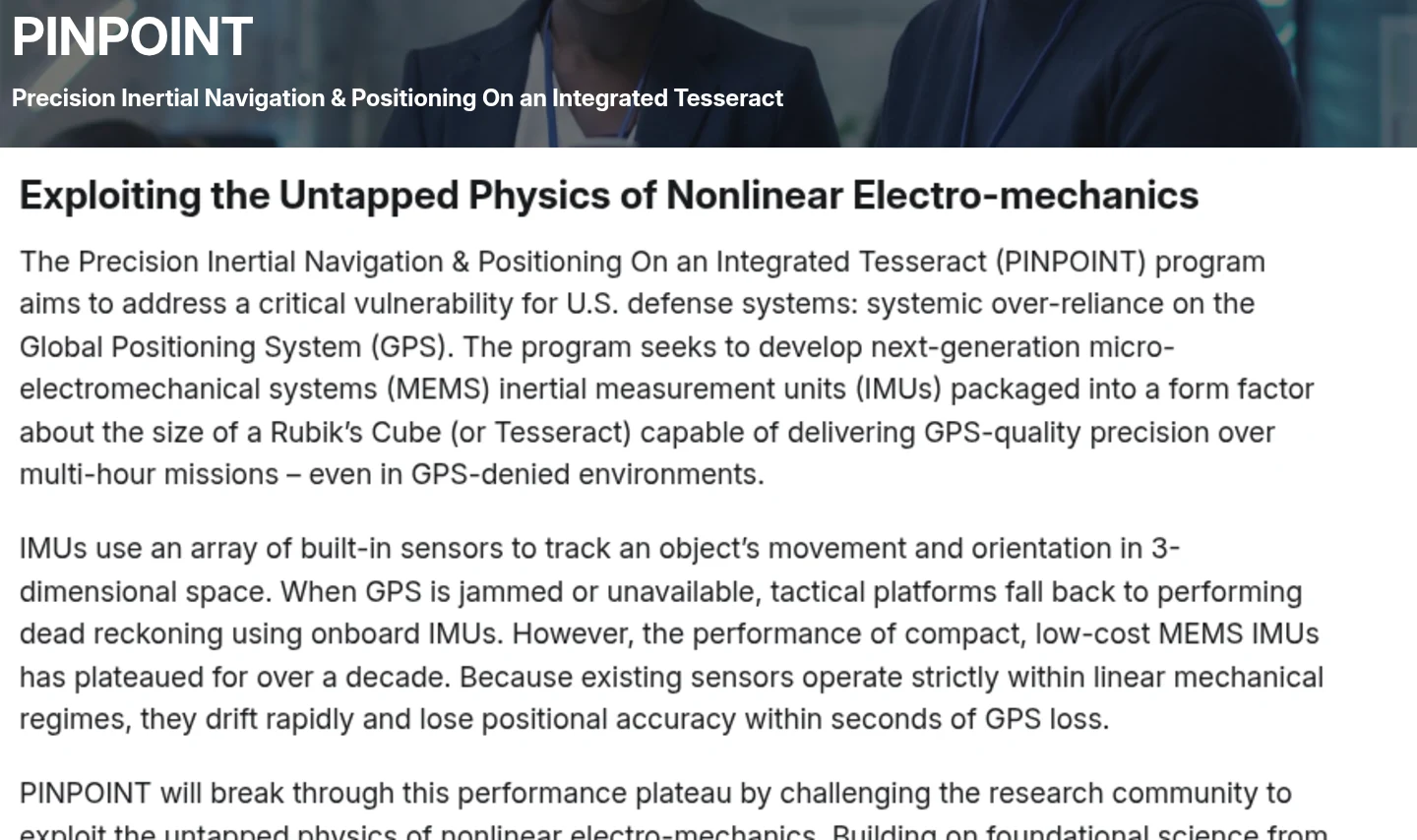
The problem, stated
The program abstract is titled "Exploiting the Untapped Physics of Nonlinear Electro-mechanics". It states that compact MEMS IMU performance "has plateaued for over a decade" and that existing sensors "drift rapidly" within seconds of GPS loss. Solicitation HR001126S0016, Defense Sciences Office.
Open source ↗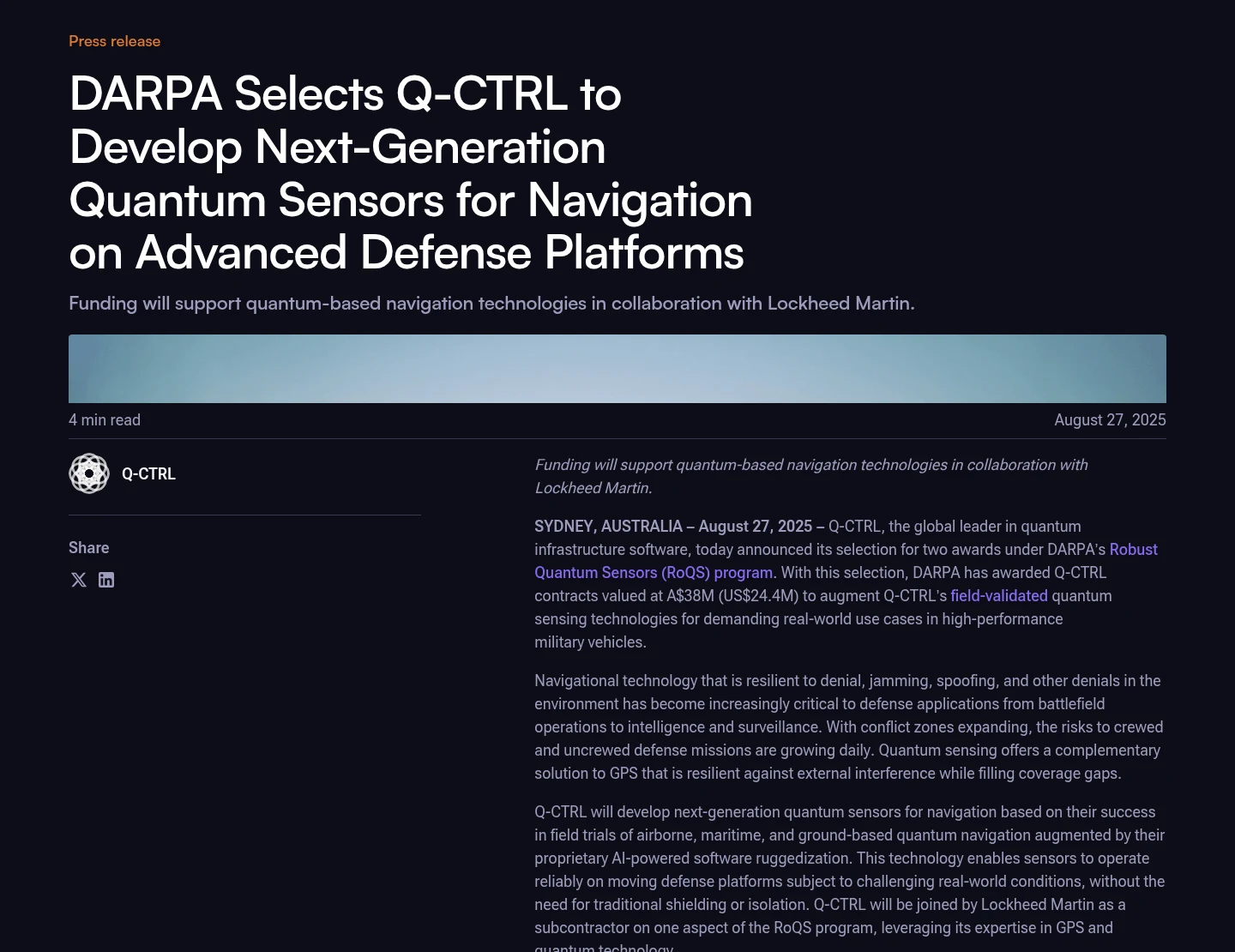
The capital, committed
Q-CTRL’s own press release, 27 August 2025: two awards under DARPA’s Robust Quantum Sensors programme, valued at A$38M (US$24.4M), with Lockheed Martin as subcontractor. RoQS exists because quantum sensors degrade under vibration and motion.
Open source ↗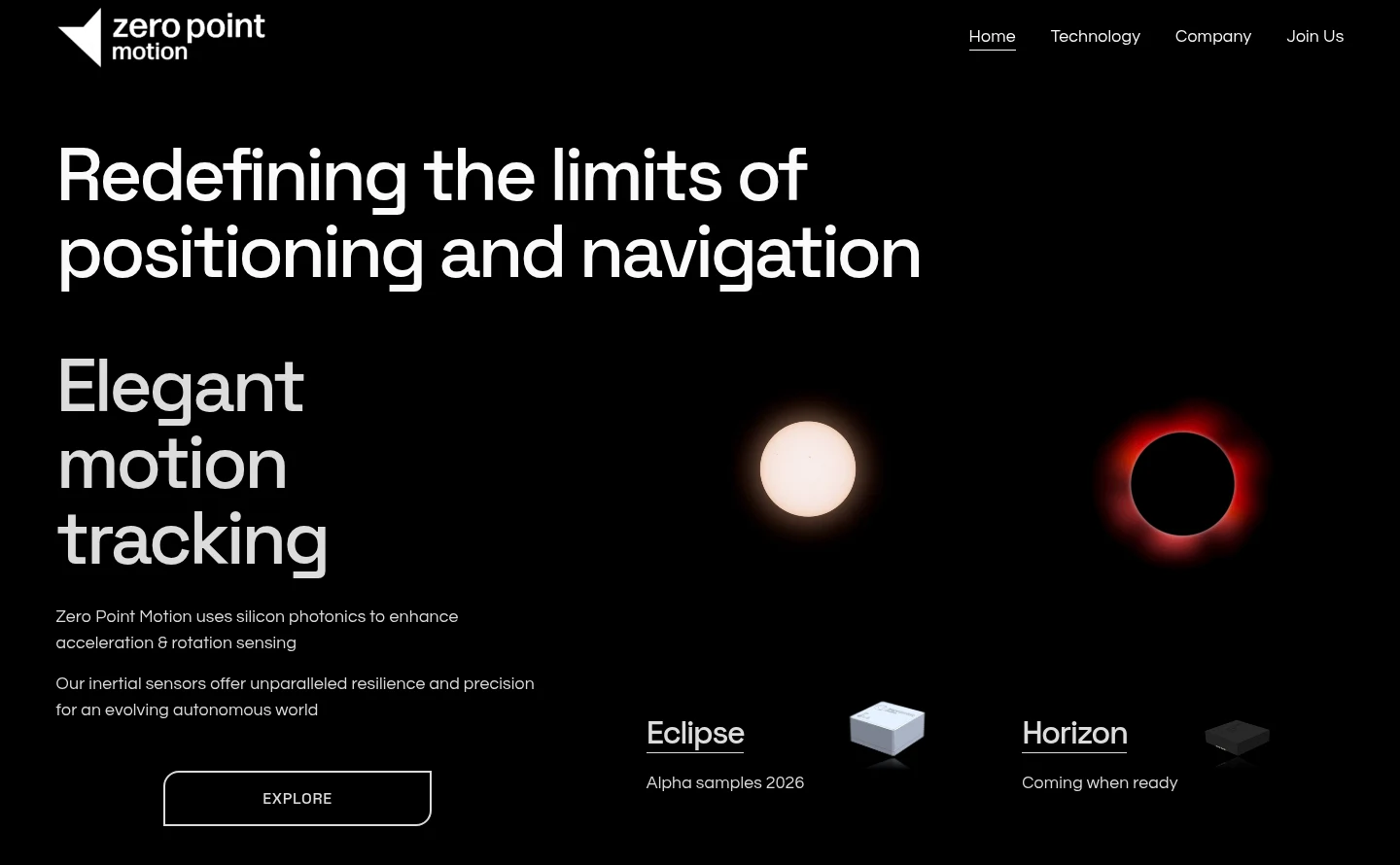
The competitor, shipping
Bristol spin-out using silicon photonics to read a MEMS proof mass. Two named products: Eclipse, alpha samples 2026, and Horizon. The closest analogue to our approach, and the clearest evidence that optical and microwave readout of MEMS is a live commercial category.
Open source ↗05
Drive the membrane and watch the cavity answer. Microwave energy in on TX, concentrated in the gap, back out on RX, and the resonance moves.
Physics model · re-entrant cavity, cut-away
Drag to orbit
Cavity transmission |S₂₁|
+0.0 MHzComputed from the cavity model, not measured. At 1.0 g the membrane moves 606 nm on a 100 µm gap and the pole moves -1.72 MHz against a 5.13 MHz linewidth: a real, resolvable shift. Two things are adjusted for viewing and nothing else: the 3D gap deflection is exaggerated ≈130×, and the 640 Hz ring-down is slowed to 1.15 Hz on screen.
06
Design frozen, cavity simulated at 4.62 GHz, every component specified and costed. The instrument itself is the deliverable, not the premise.
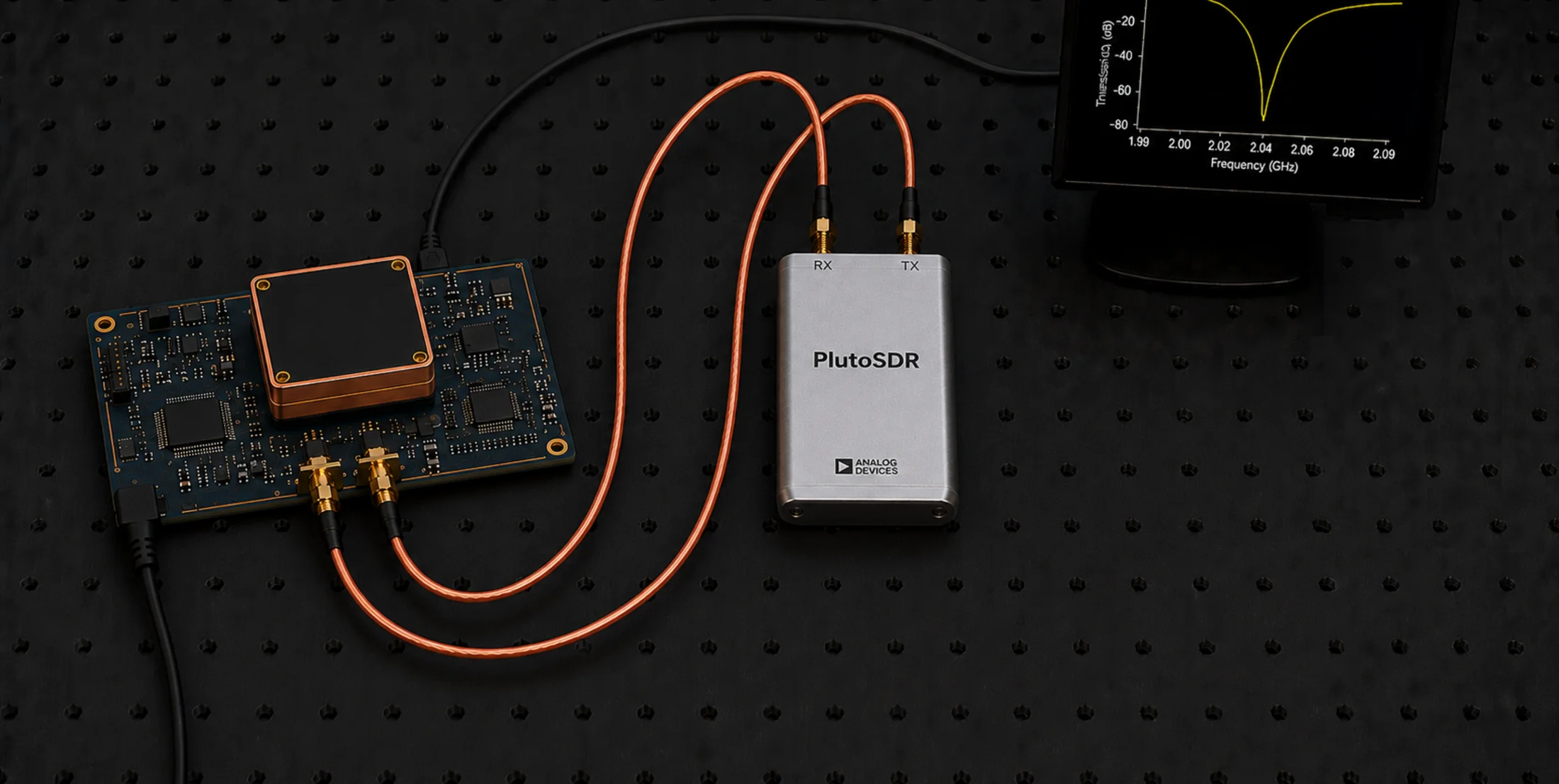
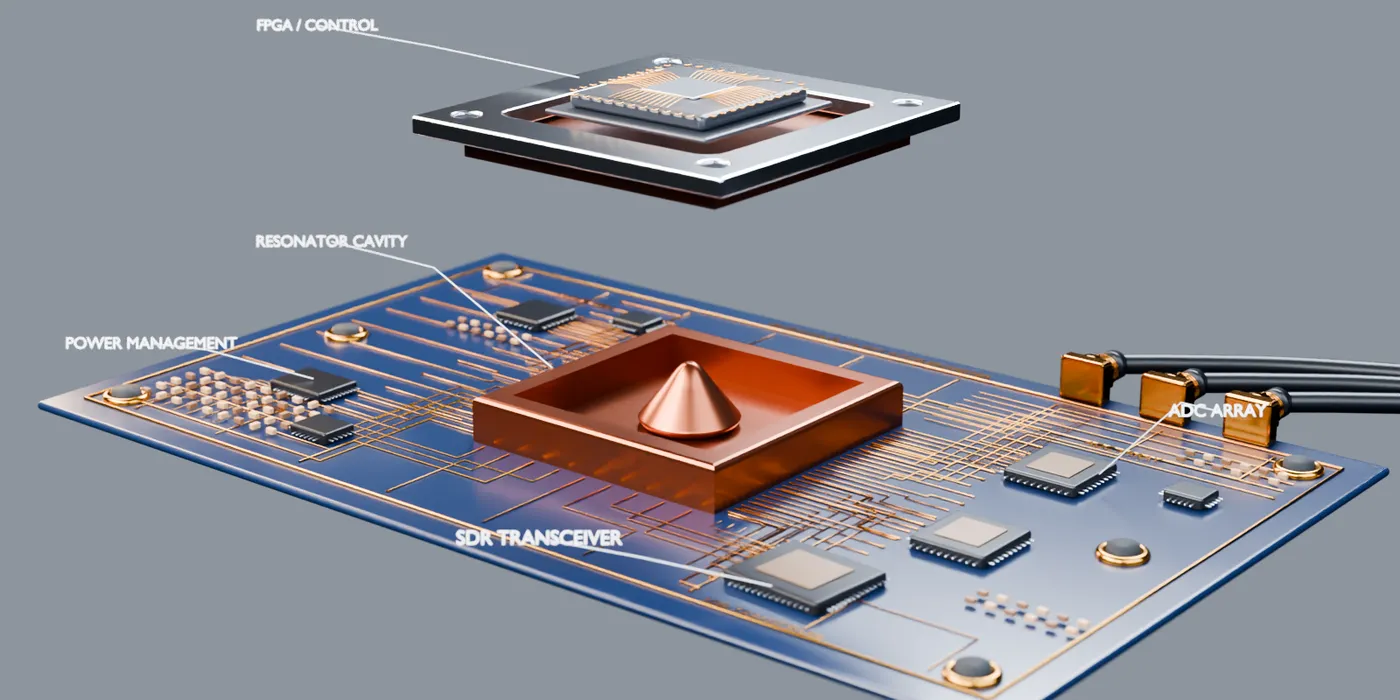
Copper re-entrant cavity mounted directly on the board, chip clamped 100 µm above the post. Carries the ADC array and power management alongside it.
Two runs to the transceiver: TX carries the excitation into the cavity, RX brings the response back out.
Full-duplex software-defined radio. Drives the cavity with a CW tone and receives phase-coherently on a common local oscillator.
Shows the cavity resonance. The distance the dip moves is the acceleration.
07
Coherent microwave interrogation and acquisition on one board, with the transceiver the only thing outside it.
Watch
Shockwave into the cavity, the gap closing, the resonance moving, and acceleration recovered from the shift.
Design animation · hardware not yet built
08
Three inertial markets, one defence number that carries the narrative, and a domestic growth rate half again the global one.
| Market | Current | Forecast | CAGR |
|---|---|---|---|
| Global accelerometers | $8.65B (2026) | $17.25B (2034) | ~9% |
| Global INS | $8.87B (2025) | $11.92B (2030) | 6.1% |
| Military inertial sensors | $3.2B (2025) | $5.8B (2033) | 7.9% |
Military accelerometers
$1.04B
32.4% of military inertial, 2025
Autonomous mining equipment
$3.99B
by 2030, from $3.12B · 5.2% CAGR
India National Quantum Mission
₹6,003.65cr
over 8 years · sensing hub at IIT Bombay
09
Defence pays for the physics. Mining is where it deploys first, and where the observability gap is widest.
Rockbursts are not instantaneous. They are the end of a long, quiet build-up: stress redistribution, creep, localised micro-fracturing. That precursor spans sub-Hz deformation through to hundreds of hertz of micro-seismicity.
Excellent at discrete events. AC-coupled, so structurally blind to slow stress accumulation.
DC-capable, but noisy, temperature-sensitive and drifting exactly where the precursor lives.
Continuous DC-coupled inertial data across the whole band, with on-device anomaly detection and local alerting.
10
Blast monitoring is built around peak particle velocity in mm/s. The precursors sit orders of magnitude below it, and part of the story is not a wave at all.
| Particle velocity | Meaning |
|---|---|
| 1 µm/s | MCEA target regime. Design target for the precursor band. Not yet demonstrated. |
| 100 µm/s | Blast-monitor trigger floor. Typical trigger threshold on a compliance seismograph. |
| 35 mm/s | Residential limit. Common guidance ceiling for blasting near structures. |
| 600 mm/s | Minor rock-mass damage. Reported onset of minor damage in rock mass. |
Amplitude. Compliance seismographs are specified and triggered for the mm/s regime, because that is what blast monitoring needs. Precursor micro-fracturing radiates far below that trigger.
Frequency. Geophones are AC-coupled and roll off below a 4.5–14 Hz corner. The slow stress build-up before a burst is sub-Hz, so it is invisible to them at any sensitivity. A DC-coupled sensor is the only way to see it.
What happens before a burst
Sub-Hz, quasi-static
The rock mass slowly reorganises around the excavation. AC-coupled geophones roll off below their corner frequency and cannot see this at all, whatever their sensitivity.
µm/s particle velocity
Grain-scale cracks radiate low-energy elastic waves. Individually far below a blast-monitoring trigger threshold, but they are the population that carries the warning.
Statistics, not single events
Event rate climbs, the Gutenberg-Richter b-value falls as large events take a growing share, and energy index and cumulative apparent volume move together.
mm/s to m/s
The event conventional monitoring is built to record. By the time peak particle velocity reaches this range, it has already happened.
MCEA targets stages 01 to 03: DC-coupled response for the slow build-up, a µm/s-regime noise floor for the micro-fracturing. Not a prediction engine, an earlier input to a decision already being made.